

India has been witnessing earlier, longer, and more intense heatwaves over the past few years, driven largely by human-induced climate change. But rising temperatures alone do not explain why cities and towns are becoming increasingly unlivable during summers. Rapid urbanisation is significantly amplifying heat stress, turning Indian cities into giant heat traps and driving a sharp rise in electricity demand.
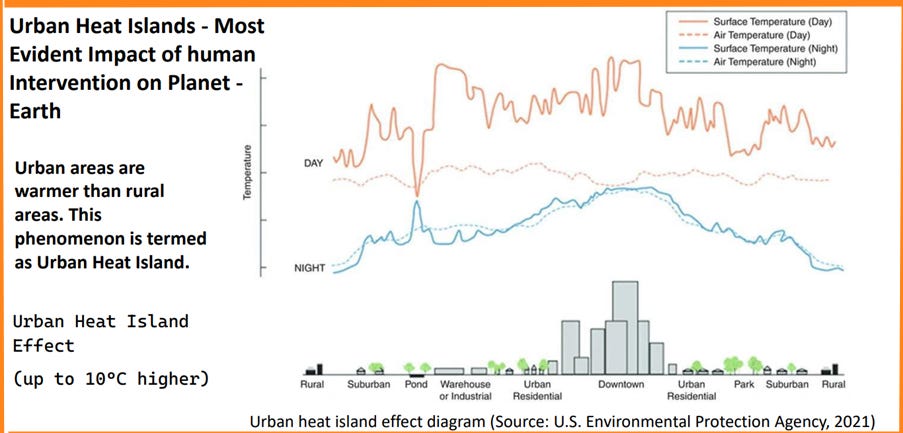
Rapid Urbanisation, which modifies land use and land cover (LULC) is behind the elevated temperature over the cities and towns, and they experience a phenomenon known as Urban Heat Island (UHI). The UHI phenomenon significantly affects us by exacerbating heat discomfort, increased energy consumption, and urban air pollution. The severity of UHI associated with heat waves and heat stress-related mortality is now one of the major concerns, particularly in densely populated cities. The observed UHI intensity varies across the country between 2 and 10 °C, with northwest India seeing a more pronounced temperature gradient.
UHI is now the primary driving factor of power demand in the country. While industrial power demand has remained relatively stable in several regions, residential demand has surged sharply because cities are becoming significantly hotter, especially during evenings and nights, forcing households to rely more heavily on cooling appliances such as air-conditioners, coolers, and fans. Air conditioners, the usage of which is rising every year at an astronomical rate, is also a key culprit in rising UHI. It is projected to cover up to 40% of households by 2030.
Non-industrial states such as Uttar Pradesh have much higher power demand than states with mega energy guzzling manufacturing zones, indicating residential cooling is the catalyst of India’s 270-gigawatt record breaking peak power demand. According to the 2011 Census data, nearly 31% of India’s population resides in urban areas, contributing 63% of the country’s gross domestic production. By 2030, approximately 40% of India’s population would likely reside in urban areas and contribute 75% of the country’s GDP. Urbanisation, in conjunction with UHI impacts in metropolitan areas, significantly changes local and regional climates, contributing to weather extremes such as higher temperature anomalies, thermal stress, and frequent and protracted heat waves extending as late as midnight.
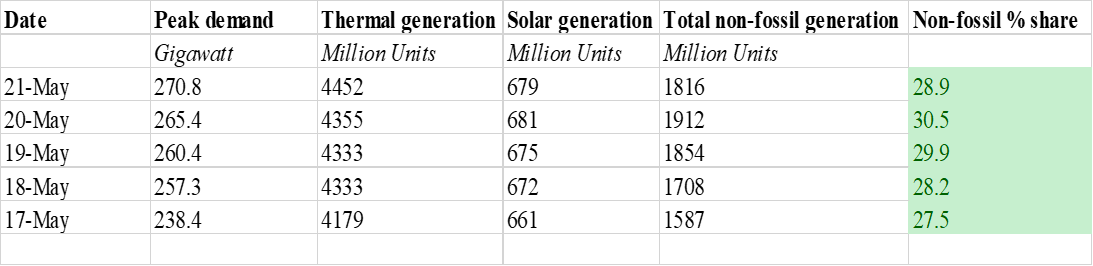
Demand trend over last week as India moved towards 270-Gw
Source: Grid India
Demand from cooling - both commercial and residential which starts from noon and doesn’t come down till wee morning hours has put grid planning in a knot. When India touched 270 GW last week, solar power was the second largest source in the supply mix contributing 80 GW, approximately 22% of the total electricity. But as the sun goes down, this 80 GW disappears and the grid has to scale up conventional sources. These conventional fuels run during the day time to support the injection of renewable energy sources and evening onwards are the only source of power.
To manage heatwave record high demand days, the Indian grid is pulling out all the stops. But heat is making the grid planners rewrite their plans and combined with ever rising RE injection, the grid is swinging between two strong push and pull. The problem is exacerbated by the weak infrastructure in the states which are currently the highest demand generator and have low RE absorption.
Urban Heat Island representation
Source: IIRS
According to a study, 32 cities around the nation show significant increases in urban temperatures and heatwaves, particularly in the Indo-Gangetic Plains, largely due to land cover changes from non-built to built-up areas. This intensifies health risks for urban residents, especially in impoverished areas, leading to heat-related illnesses and fatalities. There is a noticeable increase in the frequency of days where heat and moisture were both elevated together. 2015–2019 saw about 14,086 hot and humid days, which increased to 16,970 days between 2020 and 2024. At the yearly level, 2024 stands out with the highest compound hot-humid day count in this 10-year window.
States with the most compound hot-humid days over 2015–2024
1. Uttar Pradesh
2. Tamil Nadu
3. Bihar
4. Gujarat
5. Odisha
6. West Bengal
7. Andhra Pradesh
8. Haryana
9. Rajasthan
10. Madhya Pradesh
Data Source: CEEW
These are the same states which are the major power demand drivers as well, despite most being non industrial states. On May 21st when India’s power demand touched the highest ever of 270 GW mark, these states accounted for 60% of total demand and were in the top 10 of demand driving states. (except Maharashtra which clocked the demand of 31 GW on May 21st). But post 21st, UP’s power demand is the highest in the country, leaving behind industrial states such as Maharashtra and Gujarat.

Source: Grid India
Night temperatures are especially important
One of the most important UHI effects is elevated night-time temperature. In power-demand terms, this matters because:
cooling systems run for longer hours
buildings do not cool down as much overnight
next-day cooling demand can start from a warmer baseline
people may shift from fans to air-conditioners if nights become too warm
This can flatten the normal decline in evening demand and keep urban loads elevated longer.
The all-India average nighttime temperature shows an estimated rise of about 0.21°C per decade over 2010–2024. According ot the data by CEEW, 35 of 36 states and union terrirtories show warming on this measure. Sikkim has the strongest recent nighttime warming signal. West Bengal, Andhra Pradesh, Karnataka, Goa, Uttarakhand, and Bihar also show relatively strong increases.
Humidity and “feels-like” demand
In many Indian cities, especially coastal and monsoon-influenced ones, humidity increases heat stress. Even when air temperature alone is not extreme, high humidity reduces evaporative cooling from the body, which can make residents rely more on mechanical cooling.
So electricity demand is often shaped by combined heat plus humidity, not temperature alone. This is especially relevant in cities such as coastal metros, where oppressive night conditions can drive sustained cooling use.
UHI matters in India because it can:
raise peak electricity demand during hot afternoons and late evenings
sustain demand into the night, when cities remain warmer than surrounding areas
increase stress on city level power networks including distribution transformers, local feeders and wires.
worsen energy inequity, since households without efficient cooling face greater heat exposure while poorly insulated buildings need more electricity to stay tolerable
To mitigate urban heating in Indian cities, several strategies are recommended:
High-Albedo Roofing: Using light-colored roofing materials with high reflectivity (albedo > 0.60) can significantly reduce heat absorption, potentially lowering roof temperatures by up to 25°C compared to darker materials.
Reflective and Pervious Pavements: Reflective concrete and high-albedo pavements reduce heat, while pervious pavements promote water infiltration, cooling the surface through evapotranspiration.
Green Roofing: Implementing green roofs, which typically cover 21-26% of urban areas, helps lower surface temperatures, extends runoff duration, and reduces energy consumption, thereby improving the energy balance of buildings.
Blue-Green Infrastructure (BGI): Creating a network of natural and semi-natural elements, such as wetlands, parks, green roofs, and water bodies, helps regulate city temperatures. An 8% increase in BGI area in Singapore reduced temperatures by 1.21°C. Rejuvenating a single water body in an Indian city stabilized its temperature, indicating that a comprehensive BGI network could significantly impact urban temperature reduction and mitigate global warming and heat waves.
Off-grid Solar: Accelerating decentralised RE solutions especially solar rooftop installations is the key to effective demand management. Solar rooftop should be incentivised for households and the focus should increasingly be on low income housing.
Energy storage: The grid needs balancing and RE needs to be round the clock for stabilising the supply and decarbonising the electricity sector, respectively. The one solution to this twin problem is energy storage. Scaling up storage at grid level has been mandated but states also need to look into localised energy storage at district level powered by clean energy.
Industrial decarbonisation: As more industries move towards green energy solutions, a major chunk of economic decarbonisation is taken care of and also reduces the load on the grid.
Energy efficiency: India has a robust plan for energy efficient electric equipment and it has been successful on several parameters. Hard to abate industries which are also high energy consumers should be pushed to adopt energy efficient solutions.
Smart metering and Smart grid: Smart meters enable real-time monitoring of air conditioning usage, allowing utilities to manage peak cooling loads through dynamic pricing and demand response programs. Smart grids intelligently redistribute electricity during high-demand periods, reducing strain on infrastructure while optimising energy efficiency across residential cooling systems.
